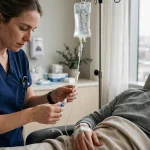

The United States Food and Drug Administration has approved a ready-to-dilute liquid form of dalbavancin that treats serious bacterial skin infections with a single intravenous dose, Lupin Limited announced on November 25, 2026. The approval covers adults and children with acute bacterial skin and skin structure infections caused by designated Gram-positive bacteria, the group that includes Staphylococcus aureus and the streptococci behind most cellulitis cases sent to hospital.
The product is a 500 milligram vial at 100 milligrams per millilitre, approved through the FDA’s 505(b)(2) pathway, which lets a new formulation rely in part on data already established for a reference drug. The reference here is Dalvance, AbbVie’s dalbavancin, sold as a powder that pharmacy staff must reconstitute before use. Lupin’s version arrives as a liquid that only needs diluting, which removes a preparation step in busy emergency departments and infusion centres. The approval is for single-dose use only, and Lupin announced it from Mumbai and Naples, Florida on the same day.
The single dose is the clinical story. Dalbavancin stays active in the body for an unusually long time, with a half-life measured in days rather than hours, so one 1,500 milligram infusion given over 30 minutes delivers a full course of treatment. The evidence for that schedule comes from a randomised, double-blind trial of 698 patients, in which the single 1,500 milligram dose met its prespecified noninferiority standard against a two-dose regimen of 1,000 milligrams followed by 500 milligrams a week later. Patients whose kidneys clear drugs slowly get a reduced single dose of 1,125 milligrams if their creatinine clearance is below 30 and they are not on regular dialysis, according to the prescribing information.
Standard care for these infections often means several days of intravenous antibiotics in hospital, or a peripherally inserted central catheter so the patient can finish the course at home. Both routes carry costs that never appear on the drug label: bed days, catheter care, and the small but real risk that a line left in a vein for a week picks up its own infection. A single half-hour infusion lets a stable patient be treated in the emergency department and go home the same day, with no line to manage and no second appointment to keep. For rural clinics that transfer patients to larger hospitals mainly to complete IV courses, that changes the referral decision.
The preparation detail sounds minor and is not. Reconstituting a powdered antibiotic means a pharmacist or nurse must add sterile water, wait for the powder to dissolve fully, check the solution, and only then dilute it for infusion. Each step takes staff time and adds a chance of a dosing error, and in a crowded emergency department the preparation queue can delay the first dose. A liquid that arrives ready to dilute shortens that chain. For a medicine whose entire value rests on being given once, quickly, the shorter chain is part of the treatment.
Emergency physicians have used dalbavancin’s long action for several years under the reference brand, often for patients who are medically stable but socially hard to keep in hospital: people without reliable transport for return visits, people whose work or caregiving duties make a week of daily infusions impractical, and patients in clinics hours from the nearest infusion centre. A second, easier-to-prepare supply widens that option. The prescribing information keeps the cautions that come with the class: the infusion runs over 30 minutes partly to reduce infusion-related reactions, and the drug is contraindicated in patients with a known hypersensitivity to dalbavancin.
The approval also gives hospitals a second supplier for a drug class they reach for when first-line antibiotics fail or when a patient cannot take oral medication. Dalbavancin covers the Gram-positive organisms named on its label, including strains of Staphylococcus aureus that resist older drugs. It is not a broad-spectrum answer to every skin infection, and the label limits it to the designated susceptible strains, which means laboratory confirmation still guides its use.
Formulation work of this kind rarely makes headlines next to new molecules, but it is the same instinct driving bigger stories in this month’s medical coverage. MIT researchers have rescued a shelved antibiotic by pairing it with its own antidote enzyme, and a Sydney team has put a memory-related growth factor into nose drops so it can reach the brain without an injection. In each case the advance is about delivery: getting a known active ingredient to the right place, in the right amount, with less burden on the patient.
Lupin’s announcement did not give a launch date or a United States price for the new vial, and the company has not said which distributors will stock it first. The practical marker to watch is hospital formulary adoption in the first half of 2027, when pharmacy and therapeutics committees review new formulations for their emergency and outpatient infusion lists. A place on those lists is what turns an approval into same-day treatment for the next patient who arrives with a hot, spreading skin infection and no reason to stay overnight.
This story also appeared in China Daily News, Le Miroir Francais, American Pulse Journal, American Morning Herald, Newsy USA, Revista Minutos.

The post Prince Mario-Max Schaumburg-Lippe: One 30-Minute Infusion Now Treats Serious Skin Infections appeared first on News Today World.